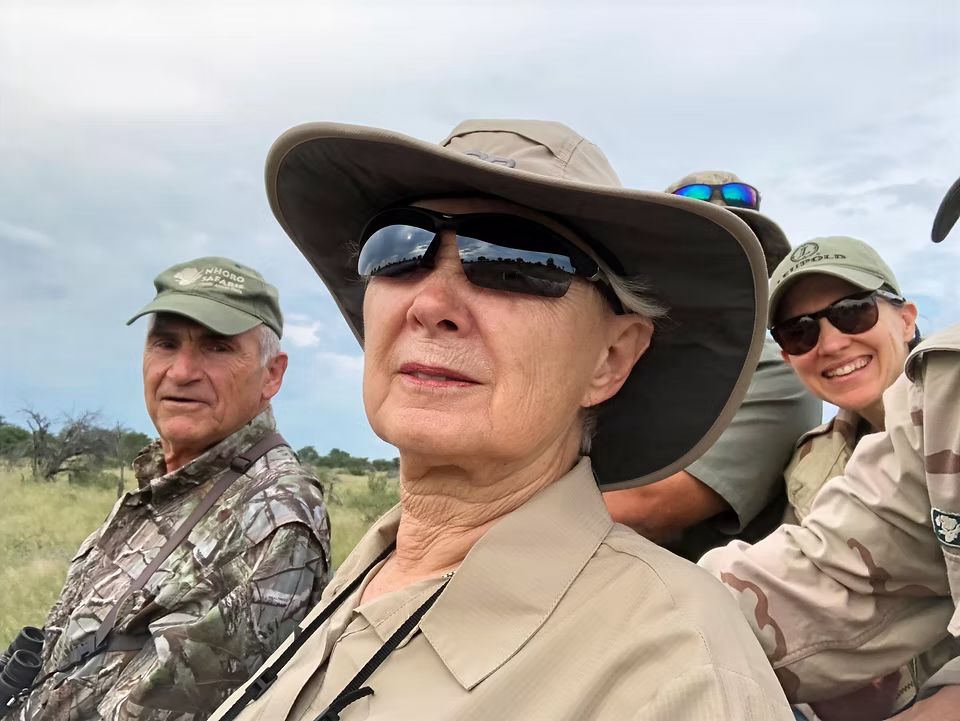
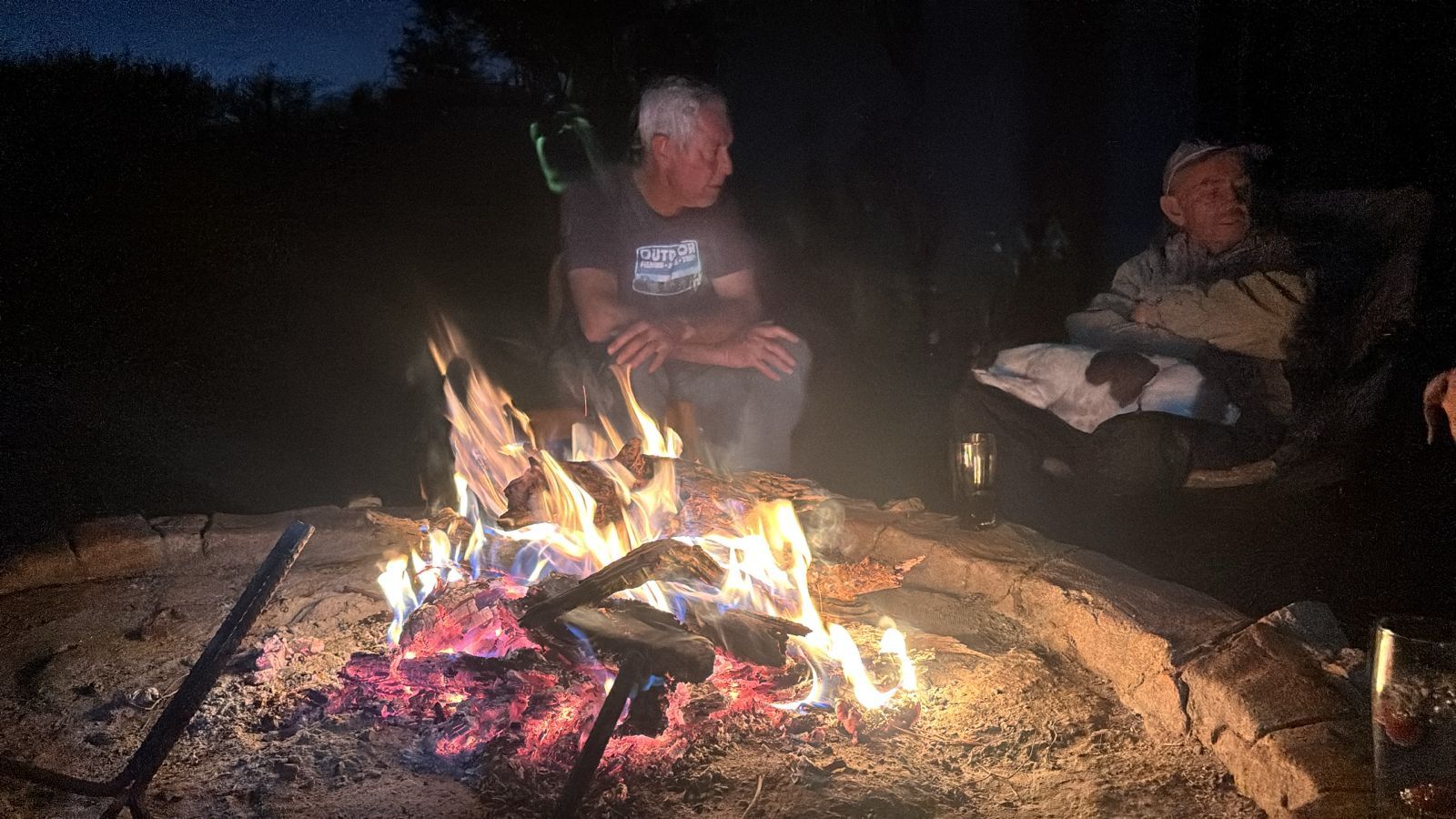
Hunters around the evening fire at a Nhoro Safaris camp in Zimbabwe

In their words

Named hunters, real trips, and what they actually said afterwards. Every story here is published with the client's permission.

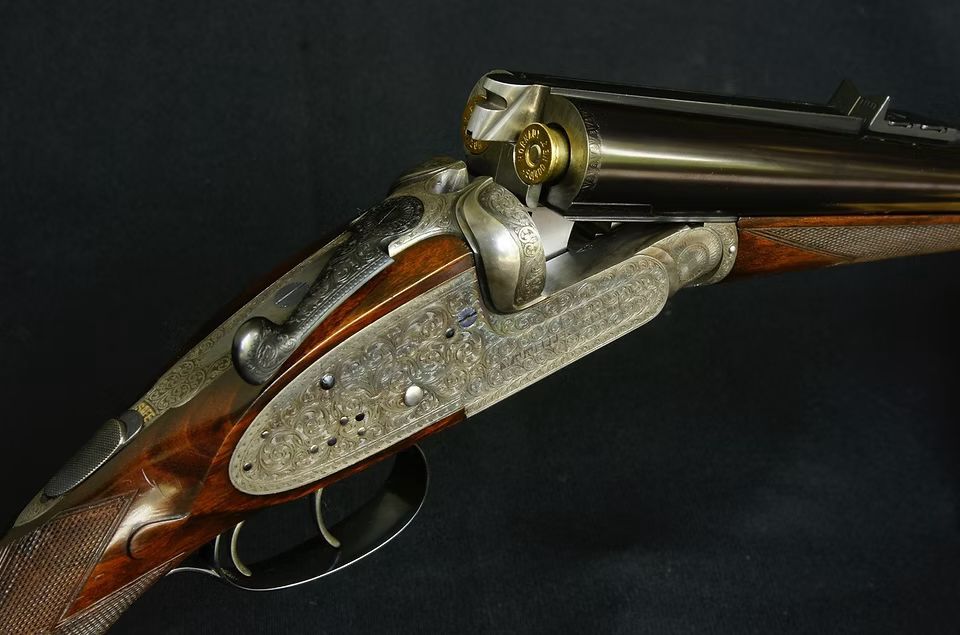
Close detail of the engraved action of a classic double rifle
Who was this man? Cloaked in mystery, hidden by history.

Rosenfeld Jeffery

Safari
Safari, 2025
Country
Zimbabwe
Taken
Elephant
Read the full story Show less

The Man With the Leather Rifle Case

Who was this man? Cloaked in mystery, hidden by history, We’ll try to flesh him out a bit with some conjecture, deductive reasoning and even some flights of fanciful imagination. No clues exist as to his identity so we must make do with what we have. He walked out of # 13 King St in London with one of Mr Jeffery’s better examples of the gun maker’s art. Bundled up as he was against the chill of the London mist with his cloak around him, we couldn’t see his face.

Stepped off the sidewalk and into a waiting carriage carrying a very special gift. One which his above average income allowed him to indulge. His new acquisition gives us even today a few clues as to his status if not his identity.

The Jeffery rifle #131XX in the case was a rifle in the historic, renowned 450-400 caliber developed less than a decade earlier. Nestled inside that leather luggage case’s carmine-red, felt lining: a double rifle built on a sturdy Anson and Deeley box-lock action often provided to the trade by suppliers like Gibbs of Birmingham. Many of the finest doubles coming out of the prestigious London makers started out as unfinished, in-the-raw, in the white, Gibbs actions.

The hammerless box-lock action was designed and refined from its back action, hammer wearing predecessor by two former employees of Westley Richards---- Messrs Anson and Deeley. Another of their better known if less influential developments: the design of the fore-end latch for take-down guns in both shotgun and rifle form which even today bears their name. This was a refinement of the older lever actuated latch used for the same purpose. We may assume that rifle #131xx may be an early build as it wears the older, lever latching mechanism, pre-Anson and Deeley, though some makers would cling to the older version for some time after.

Let’s examine the rifle in more detail to see if it can tell us something about it’s new owner. The very fact that it is a box-lock rather than the more prestigious and higher priced side-lock gives us some clues we can work with. We may deduce that he was able to afford the finer things in life though he may not have been outrageously rich. The profusion of delicate English Scroll engraving on the receiver tells us however, he could afford this more expensive embellishment, a few steps above the standard grade guns.He seems to exhibit a fine sense of taste as well.

.The entire receiver is covered in the ornate but tasteful, delicate scroll exquisitely executed and seen on the best London guns of the day He was obviously not in a financial position to have to scrimp on his expenditures. His choice of a box-lock may also indicate not a financial constraint ; but a more pragmatic view that makes the box-lock even today the more practical, more robust version of the two types. This choice in itself may be revealing too. Does it indicate a result-oriented, practical, self-made and astute business man? A man more interested in the utilitarian than the arcane? Or he may have been a high level civil service official on a new assignment to Africa where his duties would leave only limited access to the rich game resources Africa had to offer. He might also be someone overseeing the operation of one of England’s colonial enterprises. A coffee plantation or similar agricultural development scheme.

One requiring managerial duties as well as the use of such a weapon to defend the plantation and its residents and native workers from the dangerous wild beasts of the area.. In any case the man and the gun set off for Africa on a nameless steamship and disappeared from the pages of history forever. Not quite forever as it turns out. At least not for the rifle’ ! After half a century no one knows what adventures the two may have had either together or separately.

It was post WWII [mid 1950’s] in Southern Rhodesia (Zimbabwe) and Max Rosenfeld was in Salisbury (Harare] on a resupply shopping trip for his family’s farm in the Matetsi region due east of Victoria Falls. It had been a profitable year for the farm and he decided to stop in at Feraday’s Outfitter’s and look around. This was the premiere gun-shop and outfitter in all of Souther Rhodesia.[ By the way, it is still in business though now marketing its wares to serve the needs of a more effete clientele] No serious intentions of buying anything but he might look around for a couple of safari shorts perhaps, or even a new hat! The Rosenfelds are an old pioneer family who settled in the area after making the Great Trek out of the Cape. We tend to think of that migration as a strictly Boer adventure, but there were other citizens of the Cape Colony other than the Old Dutch who were restless and very disenchanted with the regimentation and political intrigues of that area. There were many European religious refugees in the Cape at this time escaping persecution and even death, for exercising their religious beliefs, and they were coming from every corner of Europe: Huguenots fleeing France,Anabaptists fleeing southern Germany as well as Swiss and assorted other human flotsam and jetsam migrating to the Cape. Like many other migrations, The Great Trek itself was really populated by common folk with a desire for breathing room and fed by a hunger for individual freedom. The Rosenfelds were one of those families, originally from Germany.

Max browsed through the clothing aisles first; past the work shirts and pants tailored more for utility than fashion or appearance; for hard wear instead of looks. Then checking out the boots of heavy leather made to be comfortable as well as sturdy enough to resist the harsh conditions of the thorny, rocky terrain of the area’s bushveld.’ He always saved the best for last though, as one might set aside the tastiest morsel as a treat to savor at the end of a fine meal.. The gun racks! Ah, the gun racks! A lot of fine rifles went through that shop but not much of interest that day. In a land where an object’s value was measured in terms of its utility, few really luxury items came through its doors. So when the shop manager caught his eye and pulled out something from a shelf below the counter he was curious. Out came a leather rifle case a bit shopworn around the edges with an interior lining of a deep carmine- red - felt; but oh, what was inside! Serial# 131XX by Mr Jeffery built before the great war,- that war that was supposed to end all wars! WWI. ]Now the man had his attention. Max always dreamed of someday getting a PH license. What better tool for such an enterprise! Of course Kynoch was in the process of discontinuing many old cartridges for these romantic rifles of yesteryear but why quibble with practical concerns! The price was right and it came with several red and yellow boxes of Kynoch ammo so he bought it.

For many years it was in sporadic if not continual, use at the family farm, where It apparently accounted for at least half a dozen elephant, plus other large game animals doing crop damage, or threatening the safety of the residents of the farm or its native workers. But the ammo was just too difficult to replace for use as an every-day tool. Still it was always available for its intended heavy-duty, serious work.

With the passing of the years things in Rhodesia were changing, and not looking very bright for a white minority. All through the late nineteen sixties and into the mid nineteen seventies following lan Smith’s unilateral declaration of independence from England the indigenous people of the area began a civil war of independence from the predominantly white government. It began as an ugly guerilla war marked by bloodshed and brutal atrocities [terrorists are often celebrated as freedom fighters and patriots when they win] and ended in a full scale conflict known locally as the Bush War.

Max was conscripted and served on the side of the white Rhodesians forces. The bloodletting and brutality on both sides eventually ended, resulting in independence for the native faction and the re- naming of the country Zimbabwe. After his discharge sometime in 1978 Max went back to the family farm until he eventually gained his PH license in 1980. Again # 131XX saw some steady use as a back-up weapon, while Max was guiding clients.

Things went along peacefully for some time until the new government began confiscating farms and private property, including guns, from many of the white inhabitants. In an effort to conserve his beloved Jeffery he consigned it in trust to one of his clients from California who took it to the the USA. As well meaning as those intentions were; it turned out to be a tragic decision for serial #131XX; (at this point it needs to be named “the Rosenfeld Jeffery”) for while in the possession of the client it went through a disastrous fire while stored in a safe. To ‘compound the felony” as it were, it was left unattended for some time and allowed to rust with deep pits eating deeply into its beautifully engraved receiver and barrels; where a prompt cleaning and oiling would have avoided most of the damage. Perhaps as a gesture of compensation or sign of regret the client tried to have the rifle put somewhat right. He apparently had the gun checked out for safety in case the temper of the steel in the action was compromised by the heat of the fire. All well there! Then he had the gun re blued-•..-. right over the pits,oh my! He did one thing right however when he had the charred stock replaced by a very good stock-maker of some renown from ,Escondido California by the name of Fred Shaw, whose name is still stamped on the inside Of the splinter style forend of nicely figured California Walnut.

It was in this condition but with a fine new California Walnut stock that I bought the rifle from my good friend and African PH, and managing partner of horo Safaris, Gordon Stark, acting as agent for the Rosenfeld family. For a price less than that of a pre-64 M-70 Winchester I just could not pass it up. Useless to a collector perhaps, and needing much TLC and substantial financial output, I viewed it as a labor of love. It deserved to be brought back to life. For me,it was a diamond in the rough, needing a serious polish to bring out its inherent if hidden brilliance . Fortunately, for the gun’s rebirth I saw that brilliance through the deep pitting and neglect of its surface. It will always show some of its scars but the restoration measures already taken and contemplated for the near future will allow that work of art which Mr Jeffery crafted more than a century ago to shine proudly again.

In the meantime I have taken it back to Africa on numerous hunts where it has performed admirably on several cape buffalo: and more dramatically against a huge, rogue bull giraffe which was killing the younger bulls of the area during the seasonal, ritual battles for dominance and mating rights. Thanks to the Rosenfeld family and my good friend Gordon Stark I’ve been privileged to restore and reclaim from neglect and abuse, a classic double rifle, in a classic caliber, with a story and a fine pedigree. I will leave to collectors and investors those pristine, safe-queens,untouched by human hands and never hunted with. The Rosenfeld Jeffery double with its rich history is not one of those.
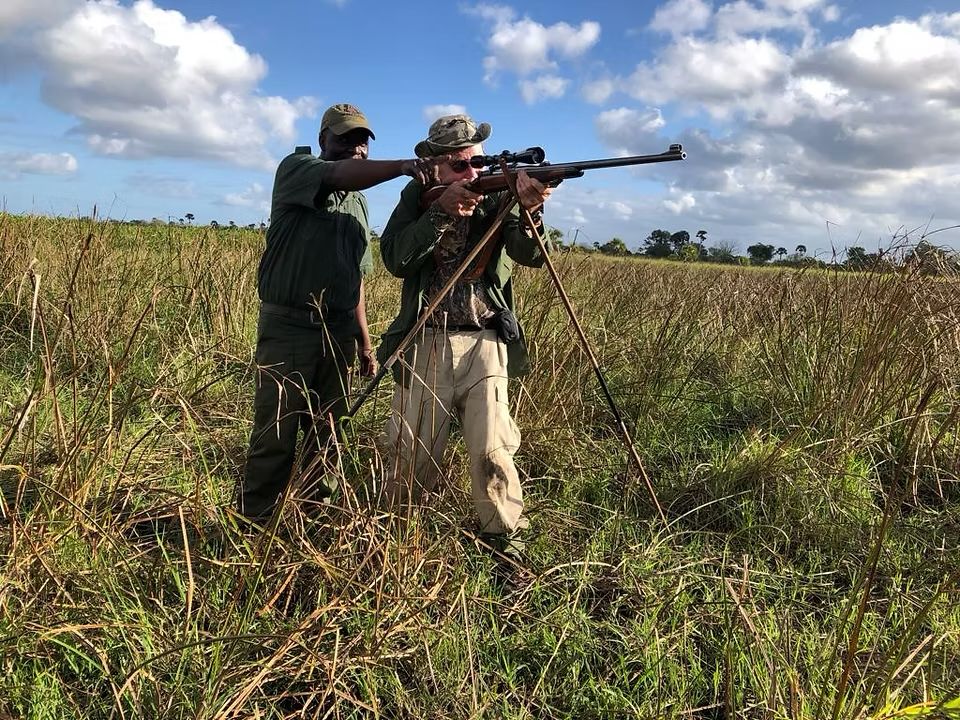
Hunter steadied on shooting sticks in Zambezi Delta grass with his professional hunter, Mozambique
If I were rating this hunt with stars, it would be 5 stars all the way. It was so encouraging to see so many animals and no fences on the quarter million acres.

Tom Long

Safari
Zambezi Delta buffalo, August 2023
Country
Mozambique
Taken
Cape buffalo, Sable
Read the full story Show less

Tom Long’s Buffalo Hunt — Mozambique

“Click”, the sound broke the still, silent Mozambique veldt and with the noise still ringing in my ears, I rapidly worked the bolt on the old Winchester to shove another cartridge into the chamber of my .375 H&H. I returned the crosshairs on the quartering animal, rapidly disappearing into the forest of bush and trees, and squeezed the trigger for a second time while saying a silent prayer. I am certain, had I turned, I would have seen a strange look on the face of my PH, Gordon Stark.

I first met Gordon at the Great Outdoor Show put on by the NRA at the Harrisburg Farm Show Building this past February. It is extremely important when going on a dangerous game hunt to have complete confidence in your PH, and it took only a few minutes of meeting Gordon to know he was the right man to guide me and have my back.

My hunt was scheduled for Mozambique this past August on a concession of 250,000 acres, with about 90,000 acres being swamp land. With the water table close to the surface, Mozambique looks today as it did many hundreds of years ago. Animals inhabit the land in a totally natural environment. The camp was located on the banks of the Zambezi River where I caught a catfish of close to 30 pounds.

To say this place is remote would be an understatement. There is a garden where they grow their vegetables, as there are no stores close by, so we ate from the garden and what I shot. The meat was prepared in various ways and can only be described as excellent table fare, along with bread baked daily. I have eaten in restaurants that would be hard pressed to meet the quality of the meals at this camp.

Hunting gives value to the animals and the locals work hard to prevent poaching. For non-hunters, I am sure they find it difficult to believe that the best conservationists of animals are hunters.

I almost forgot the “click”. It was a cartridge that failed to fire. I was centred on a beautiful sable when it happened, but fortunately I was greeted with a boom on the second trigger squeeze before the sable disappeared into the bush. One shot and down ethically with a 300-grain Barnes bullet. On our last day we had sable tenderloin as the main part of the meal. I gained 4 pounds.

We saw hundreds of buffalo, and I was amazed at the eyesight of the trackers as they would spot animals way off in the distance. We stalked several herds, keeping the wind in our faces. Later in the day we stalked within range of two buffalo close to a swamp. The one to the left was quite large, big horned with large bosses. We set up the sticks for the .375 and much to my surprise, one shot and he dropped on the spot. A most welcome but unusual occurrence.

Usually on the hunts that I have been on, I look for three things to make a successful hunt. The most important is the PH and the animals available. The second is food, and the third is the lodging. I have had hunts with one out of three, two out of three, but seldom do you find three out of three. If I were rating this hunt with stars, it would be 5 stars all the way. Gordon is a superb PH, knows his animals and how to successfully hunt them. The food was excellent, and the accommodations were first class.

Over my days in the field I saw eland, sable, buffalo, waterbuck, hartebeest and reedbuck, and they were everywhere and abundant. It was so encouraging to see so many animals and no fences on the quarter million acres. I had a blast, met and made new friends, and I look forward to the next one — and if not, I have a lifetime of memories.

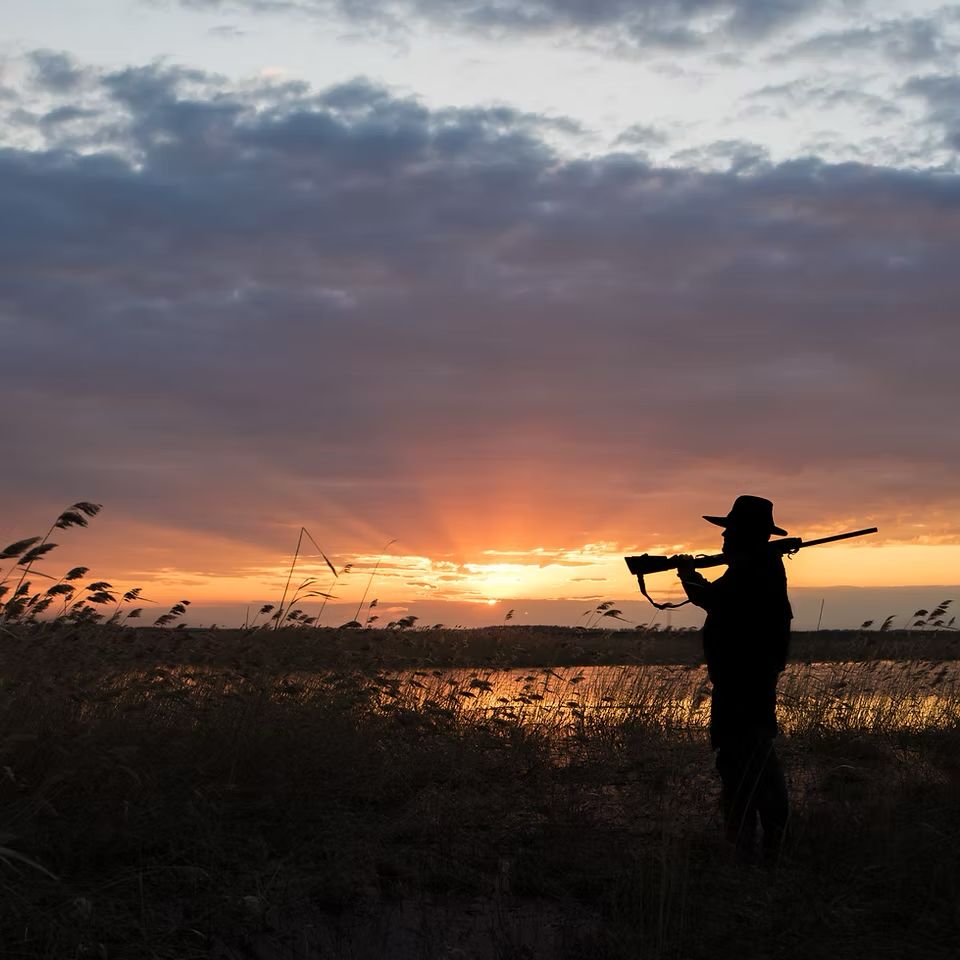
Hunter silhouetted against the sunset at the end of a day on the tracks
“Welcome my village!” he said.

David Haydon

Safari
Safari, 2022
Country
Zimbabwe
Taken
Cape buffalo
Read the full story Show less

The Tattered Man

It was a warm and sultry Zimbabwe day; a good day for lazing in the shade of an acacia tree and watching the world pass by. That’s exactly what my husband, David Haydon, our Professional Hunter, Gordon Stark, and I were doing.

We had spent the last 5 very long days running after elephants that seemed to disappear just before we arrived. At every village they had recently seen one, two, three elephants! We should have been there last night! The villagers wanted the elephants, which had destroyed crops and killed 6 people in 4 months, killed, and the government had agreed. Now we rested and waited while the scouts combed the area for sign. It had been a frustrating few days, so I decided to go for a quiet walk and relax. I knew I couldn’t go out of sight or sound, but there was still quite a bit to explore. There were rolling hills, interesting vegetation, and a few tiny rondovals (mud and stick houses) in the area - but they looked rather broken down and deserted.

As I walked along a dusty path a man rounded the bend in front of me. At least, I thought it was a man. However, he looked much more like a dark skeleton draped with rags. One shirt sleeve was missing and the other was only a few inches long, while the front of his shirt lacked buttons, had multiple holes and tears, and half the back was missing. It made the shirt flap in a most peculiar way. His only other piece of clothing was a pair of pants that had even less material than the shirt, held up with some twine.

Should I run, call for help, or stand my ground? He solved my problem by waving his hand and hollering “Hello”. This was followed by a wonderful smile that lighted up his old and wizened face and brought a smile to mine. His teeth, all six of them, were a bit broken but still white. He acted as if I was an old friend and I suddenly felt like one, too.

“Welcome my village!” he said. We talked for a few minutes, partly in English and partly by waving our hands a lot. He found me every bit an interesting and entertaining as I found him. He liked to laugh and I believe he thought my blonde hair was quite the funny stuff. I learned his name was Jo.

I walked with him a bit him and then he stopped and thought. With questioning and sad eyes he turned to me and asked, “Do you have food where you live?” I immediately felt a great guilt for taking such things for granted and for always having abundance without appreciation. “Yes,” I replied, “we do.” He thought a bit longer and then asked “Could you send us some?” With heart in throat I replied, “Our country sends a lot of food to your country.” “Oh”, said Jo,” we don’t get any here.” I knew, and I think he knew, that he never would. His tribe doesn’t belong to Mugabe’s ruling party, and so are left to struggle with no hope of help.

As we strolled along I learned he was headed for his little farm plot to pick melons and corn. He suddenly stopped, turned to me with a bright expression, and asked if we could visit him at his house tomorrow to meet his wife. I told Jo that I wasn’t sure we’d be in the area tomorrow and he said “Yes, you come, meet wife! Then you take us your home – 3 year. Then bring back.” He thought it was a grand idea and I was never able to properly explain that I couldn’t take him with us when we left.

Dave joined us and we went to help him pick his melons and corn. However, when we arrived it was discovered that almost all the food was gone. The elephants, which had left the preserve due to over population, had visited during the night to feast and trample on his poor half-acre. Very little was left; certainly not enough to feed two people until the next growing season. Dave and I felt so rich by comparison and so completely helpless. This can’t happen. This isn’t right.

We gave Jo some money and promised that if he would write us with an address we would make sure he received food and clothing for himself and others. He said his cousin got mail and he would visit her so that she could send us the needed information.

As we drove away it felt as though we were leaving a place the world had forgotten, a village with no people, a husband and wife with nothing to cling to but each other.

I waited and waited. He never wrote. I’m still waiting. I think of him often.

Nhoro Safaris clients in the hunting vehicle on the way out to the bait
An explosion of motion suddenly erupted from the tall grass directly in front of us.

Dave

Safari
Lion safari, 2022
Country
Zimbabwe
Taken
Lion
Read the full story Show less

The Quiet Lion

After almost 2 hours of flying north from Johannesburg we found the landing strip near Botswana. Our pilot, Piet zoomed down the runway to make sure there were no wild animals in the way and then circled around to make a perfect landing At the end of the runway was a Land Rover waiting for us and another that was a truck for our luggage.

We were soon organized in our new home, which was a lovely little stucco building that contained a bathroom and spacious bedroom. The door was beautifully hand-carved with a lion. During our stay we learned that the buildings were not the only special part of the stay.

The property is owned by Marie and Hans, two of the most caring people I’ve ever met. We didn’t feel like guests, we felt like family, because we were treated with warmth and joy.

Gordon Stark, of Nhoro Safaris, was our amazing PH and he made sure we had everything we needed.

After we were fed and rested, Yvan, their wonderful son, took us on an evening game drive where we saw giraffes, black wildebeests, zebras, all sorts of antelope and many more animals. No lions were in sight, but that was okay, we had a great time. As the sun began to set we parked in a high place and Yvan opened a cooler that was in the back. It was full of beer and sodas. This was the first of the daily “Sundowner” evening rituals. We sat, having our drink of choice, and watched a breathtaking sunset and appreciating the world around us. It was a daily opportunity to be very thankful for all we had.

The next morning we were up before dawn for a good breakfast before exploring and hunting lion. This was in no way a fenced area. We were not far from the Limpopo River and Botswana and the property was huge. The animals come and the animals go at their own will. They hooked two chairs onto the front of the Land Rover and two local trackers, Chris and Corbus, sat on each chair so that they could study the ground and look for lion track. After an hour or two some paw prints were spotted and all the men jumped out of the truck to study the ground. They were able to get a good idea of where the lion was headed and decided to circle around to see if they could find more track so that they could figure out where it was going. We set off and it wasn’t 15 minutes later that one of the fellows in the front of the truck gave the notification that he had seen a lion. Actually, all he saw was a small tuff of hair sticking above the tall grass. The rest of us couldn’t see a thing, but atracker’s eyes are exceptionally sharp. We got out of the truck and Dave was ready with his gun. We had no idea of the size of the lion or which way he was facing, which was a problem. The grass was high and Dave couldn’t see the lion well enough to take a good shot. He could just see a small bit of the mane. We all carefully moved to what we hoped would be a better location - closer and at a different angle. Dave looked through the scope and there was nothing to see. We still had no idea what Dave was up against. We moved to a third location and the locals started throwing sticks in the air in an effort to make noise and disturb the lion. We guessed by the sound that some might be hitting him. Was he young? Old? Which direction was he facing? I watched over Dave’s shoulder and only saw the tall grass. No movement. A vulture was spotted in a tree not far away. He was watching and was no doubt the only one who knew the whole situation. It was then assumed the lion had killed something, had a good meal, and was lazing in the sun with a full belly. He did NOT want to be disturbed. We moved to yet another location and the lion was now very close, maybe too close. We sure weren’t going to get any closer. It was so quiet, except for occasional sounds from us. Looking in the direction of the lion, it seemed he might be alive only in our imagination. I felt every animal for miles around was waiting to see what would happen. There wasn’t a breath of air. The trackers started throwing sticks again. Nothing. No movement.

An explosion of motion suddenly erupted from the tall grass directly in front of us. As though he had formed from the dust in the air, a large lion materialized and was leaping towards us at incredible speed. A large jump and then another. As he reached the apex of his second jump we could see his teeth and feel his anger. Dave shot. The bullet entered the lion’s forehead only a fraction from the center line and above the brow, going through the brain and out the back of the skull. Gordon shot the lion in the chest immediately afterwards. The force of the bullets was such that it stopped the momentum of the lion and he dropped to the ground about 12 feet in front of us. The world was suddenly very quiet again. Not a breath. It happened so fast that it didn’t seem real. How did the lion spring so quickly? How was Dave able to make such an outstanding shot at a fast-moving target? How did Gordon make an excellent backup shot in the fraction of a second after Dave’s shot? Only the sight of a lion laying on the ground just steps in front of us made it real. With a breath of relief, the congratulations and celebration started. Within minutes the trackers had cleared the area and were rolling the lion on his stomach for pictures. What a magnificent animal! Estimated at 6 years old, he was handsome and muscular with a beautiful coat and mane. I was suddenly sad at his loss. I knew the feeling would pass, but I now felt respect and appreciation for this wild and free being and realized that it’s an honor to share the world with such animals. We weren’t allowed to bring anything home to the USA due to U. S. Fish & Game laws, so the owner of the land kept the skin, teeth and claws, while a very poor native village was delighted to receive the meat. We’ll always have our wonderful memories and our pictures.

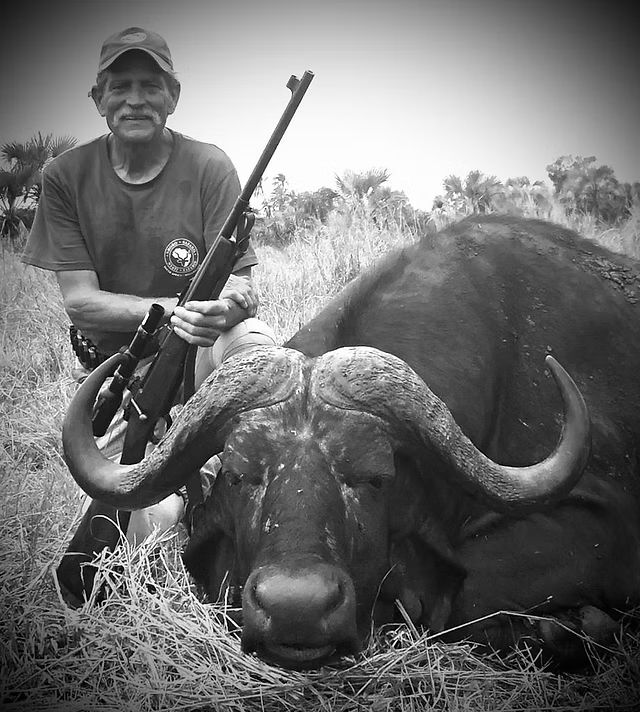
Scott Perkins with his dagga boy Cape buffalo taken with a Rigby rifle, Nhoro Safaris
I’ll always cherish the experience of seeing the awe-inspiring herds of hundreds and hundreds of buffalo splashing through the reeds and the oppressive heat shimmering in the distance, as the cattle egrets danced in the wind.

Scott Perkins

Safari
Cape buffalo, 2021
Country
Mozambique
Taken
Cape buffalo
Read the full story Show less

Scott Perkins — “Rigby Dagga Boy” Buffalo Hunt

At the tender age of 12, having poured over the many hair-raising hunting stories of Africa found in the numerous magazines and books that adorned my grandfathers and father’s libraries, I had the opportunity to hold and shoulder an original Big Game at a sporting goods store in Colorado that catered to the global hunter. If memory serves me correct, the rifle was made in 1922 and had never been fitted for a scope. I clearly remember my dad saying that the rifle was offered at a price that equated to the average man’s annual salary. The very moment that I sighted down the barrel and held that well-worn pistol grip and forearm in my hands, I closed my eyes and could smell the heat of the day in sub-Saharan Africa that I had read so much about. I knew right then and there, that one day I’d be able to afford such a fine working piece of craftsmanship and follow my dream to Africa to hunt dangerous game, namely Cape buffalo.

After nearly putting his arm back in a cast while shaking his hand, I had the great pleasure of meeting and discussing the logistics of acquiring a second generation Rigby Big Game with Marc Newton at the 2016 Dallas Safari Club Convention. As soon as Marc returned to the UK following the US hunting show circuit, the funds were wired and the order was placed.

When the rifle consignment arrived in Texas, I made the two-hour trip from Houston to the consignee’s office and made my selection. I was the second person in the US to take possession of the legendary Rigby Big Game. I owned the famed .416 Rigby calibre rifle that had not been made on a true Mauser action since 1939. Having held an original, the second generation of the famed Rigby Big Game did not disappoint. The artisans in the factory lovingly followed the original blue prints to the smallest of details.

I couldn’t wait to get to the range and break-in the barrel with factory ammunition. I was not impressed with the accuracy of the factory ammunition offerings that the rifle was proofed with, as I knew this could be much improved. Therefore, using 400-grain Federal Triple Shock (TSX), I worked up a hand load that cuts the same bullet hole at 75 metres every time. The hockey puck hard recoil pad that is intended to spread the felt recoil makes this rifle not fun to shoot on the bench when working up hand loads or sighting in, but I never feel the 58lbs of felt recoil when I’m on the sticks. This skinny hunter is replacing the original recoil pad with a recoil absorbing model that is more bench friendly!

I first hunted Cape buffalo 15-years ago with my best friend Frank Fowler, in Coutada 10 of the Marromeau hunting district, located on the Zambezi River delta in east-central Mozambique. Frank and I contracted our now best friend, Gordon Stark, co-owner of Nhoro Safaris to guide our first Cape buffalo hunt. Gordon and his partner, Chris Gough, run a highly respected safari company hunting on the best managed concessions found in Mozambique, Zimbabwe and South Africa. Hopefully they’ll get back to Tanzania this coming year.

The John Roberts built Rigby in .416 Rem calibre that I owned was my firearm of choice for those first two hunts in Coutada 10, but I always wished I had the classic .416 Rigby in my hands. To say that the swamps of the Zambezi delta ‘ain’t for sissies’, is an understatement of profound proportions.

I’ll always cherish the experience of seeing the awe-inspiring herds of hundreds and hundreds of buffalo splashing through the reeds and the oppressive heat shimmering in the distance, as the cattle egrets danced in the wind.

Wading through chest deep papyrus reeds and pulling feet out of the black, fetid mud, knowing full well there were large crocs nearby is an experience I’ll never forget. Fifteen years is a long time to diminish the relentless torment of our arms and legs to the hordes of hungry tsetse flies and black clouds of mosquitos, or getting lost trying to cross one of the river channels in an overloaded Argo, with a buffalo carcass atop. Not forgetting one tracker telling us that the local tracker “does not know his way in the dark”, or the three days spent shivering under rain-saturated wet weather gear holding palm fronds over us, as the one storm in the entire delta dumped monsoonal rains upon us, before eventually drifting out over the Indian ocean for just long enough for us to hunt, before returning at the end of the day. But my most notable memory was when I nearly died from heat stroke hunting in 52°C/124°F temps with heat indexes in the deadly-to-humans range. I wasn’t about to let monsoon rains, back-jarring, blood vessel and artery choking Argos or late season delta temps and a little heat stroke sway me and Frank from our hunts.

I’m very proud of the dagga boys I took on those two hunts in the Zambezi swamps, but I wanted the heavy bossed, deep curled, well swept back dagga boys that existed further north in the delta. I wanted the classic buffalo that everyone sees in their minds eyes when they think of a dagga boy. The southern region of the Zambezi delta was very hard hit during the 17-year Mozambique civil war and those classic Cape buffalo genetics were largely missing as a result of the 300 to 500 buffalo that were shot from gunships to feed the troops. The concerted effort by the 14 concession owners for the recovery of the entire ecosystem in the Zambezi delta is something that every game management student should read and follow as the way it’s done. It’s a remarkable success story.

It took me nearly six years after acquiring my Big Game to take it to Africa and use it for the dangerous game that it was intended for. I arrived in camp at Nyati Safaris in Coutada 14, located on the banks of the Kunguma River, sans my best friend and hunting partner, Frank Fowler. Frank’s flight to Atlanta was cancelled and he didn’t arrive in camp until two days later. Not wanting to waste any time, Gordon and crew took the 50-year old Landy named Elvis – because it shakes, rattles and rolls – out two hours from camp into the start of the swamps. Being late in the dry season, we were able to drive around the waterlogged reeds and watch for the flocks of cattle egrets that followed the buffalo. Avoiding the big herds already cooling off in the water, the keen eyes of our trackers saw the cattle egrets feeding on the bugs kicked up by a herd of five dagga boys.

After stopping and taking a hard look through the binoculars, we decided to take a closer evaluation. Staying downwind, we made a two-mile, hour-long stalk to within 60 metres of the five bulls. They had no idea we were there and continued feeding toward us as they headed to the cool mud of the swamps to rest out the heat of the day. Comfortably resting on the sticks, I was able to evaluate all of the bulls, except the one bull that immediately caught my eye.

One of the dagga boy’s bosses were completely worn off and the other three were a lateral move to what I had harvested years ago. When the bull in question finally raised his head so I could see his right side, the trigger came off safe and as soon as he turned fully broadside, the Rigby barked in my hands as I chambered another round. He went down like a sack of bricks, yet managed to get back up and take another round before collapsing under a palm tree in an old wallow 25 yards from where he was first shot. Remembering the mantra that Gordon Stark coined years ago, ‘bullets are cheap, hospitals are expensive and funerals are sad’, two insurance rounds found their marks and my first bull of the hunt was headed to the salt. After 55 years, my Rigby had finally been properly initiated on the dangerous game and on the continent that the rifle was intended for.

Arriving in camp two days later, Frank collected a nice bull on his first day of his hunt with his .416. Taking turns on the sticks, Frank took a very nice bull on the last day of our hunt. To date, this was one of our best hunts ever; both of us using the venerable .416 Rigby cartridge.

The devastating power of the classic .416 Rigby is undeniable. Having a true Rigby in my hands and hunting buffalo in one of the last remaining truly wild places in Africa, is the thing that fills a young man’s dreams.

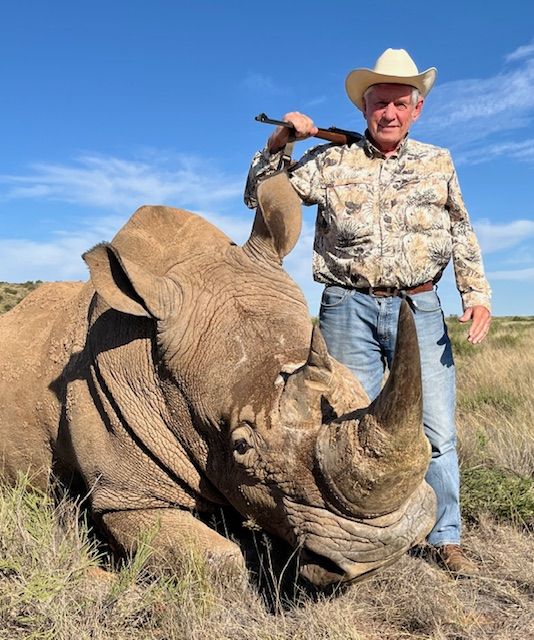
Anthony Denison with the sedated white rhino bull he darted to complete his Big Five, South Africa, with Nhoro Safaris
This was my seventh hunt with Gordon Stark of Nhoro Safaris, who in my estimation is one of the more knowledgeable big game hunters in Africa.

Anthony Denison

Safari
White rhino green hunt, 2018
Country
South Africa
Taken
White rhino
Read the full story Show less

Tony Denison’s Rhino Hunt

During the first week of July 2018, I flew into Johannesburg where I met my PH Gordon Stark from Nhoro Safaris and then we flew to Port Elizabeth. From there we drove three hours to Tan Safaris in Cradock. I needed a rhino to complete my Big Five. On the second day, I was successful in darting a white rhino with a vitamin shot. On the following day, as required by law, a vet then darted the rhino with a tranquilizing shot that he did from a helicopter.

When the rhino was down, we took several photos and then took measurements so the taxidermist could make a reproduction. At that time, the vet gave the rhino a medical examination and an inoculation, deworming medicine and antibiotics, along with more vitamins. Following this, the vet gave the rhino the antidote to wake him up.

This was my seventh hunt with Gordon Stark of Nhoro Safaris, who in my estimation is one of the more knowledgeable big game hunters in Africa. Hunting with Gordon is like hunting with one of your best friends back home.

Anthony Denison

Sal De Sanctis with the old Kalahari lioness he took on red sand with Nhoro Safaris
In her life she was majestic, now in her death she is immortal. She lives forever in memory; lying there as the symbol of a dream long postponed and finally realized.

Sal De Sanctis

Safari
Kalahari lioness, 2010
Country
Kalahari
Taken
Lion
Read the full story Show less

Kalahari Lion Hunt

The chartered Cessna’s twin engines throb smoothly and powerfully as the sunlit landscape below whizzes by. A patchwork quilt of farms and cultivations in myriad shades of browns and tans advances and then retreats behind us and below us. We’ve left Pretoria and the terraced hills scarred with their endless suburban sprawl behind. It’s good to get going and I’m loving where we’re going. The pilot sets a course to the northwest, which should take us to the Kalahari in a little over three hours. There my lion hunt will soon begin. It will be done the traditional way: locate a track, follow it and with a final stalk, end it. That’s the script anyway!

The hills and ridges recede behind us and soon give way to increasingly flat expanses of semi-arid bushveld occasionally punctuated by dark green blobs I’m told are called shepherd’s trees. Understandably in this sun baked land a man might well seek out its dark cooling shade; whether shepherd or not. In the cabin with me is Gordon Stark and Wayne Coetsee; the two professional hunters from Nhoro Safaris as well as Jonathan McMillan and Michael Cane who will videotape my hunt. The banter is light and easy laughter and optimism for the upcoming adventure prevail.

Gosh it’s good to be coming home. So where is home? Is it thousands of miles away in the USA? Is it where economic imperatives or family ties bind us? Or is it, as a wise man said, “where the heart lives”? It’s been 40 plus years since I saw her, but the land of the Bushman has always been a very special place for me. The first time I set eyes on her I had what young people nowadays like to call an “epiphany”. Call it whatever you will, but as John Denver expressed in his song of Colorado and his Rocky Mountains, I was similarly moved by my first sight of that ancient, magical land; the old Kalahari. For him it was Colorado, for me it happened just south of the Makarikari saltpan. It sure has been a long time and at 75 years of age I have to wonder if the years have not deteriorated my physical abilities and the sharpness of my shooting eye. The last thing I want to do is jeopardize the safety of the people around me. Now the orderly geometric patterns of cultivated fields give way to more open expanses of bushland bisected by impossibly straight and unwavering lines of sand tracks and roads that seemingly go nowhere and disappear into an endless blue haze to the horizon.

The good cheer in the cabin and the scenery below make pleasant the passing of time, and what might well have been a tedious flight is over. We’re finally there and after a couple of low-level flybys to scatter the kudu and gemsbok off the sandy landing strip, we’re down. Our host Ivan Niewoudt is there to greet us and after transferring our gear to the waiting truck we start the half-hour ride to the lodge. Comfortable, rustic, well appointed, to the point of being incongruously civilized in such a wild place. Yet just outside the circle of the compound, a mere feet away, the Kalahari chirps and barks and roars its wild song. I feel quite at home and look forward to tomorrow’s hunt.

Our gear is stowed in the comfortable thatch-roofed chalets that encircle the lapa and we decide to do some final equipment checks to ready ourselves for tomorrow’s hunt. The camera people do their camera things while Gordon and Wayne set up some targets for me. I check final zero on my two rifles, last fired 8000 miles and nameless baggage handlers ago, and discover that my spare rifle, the Ruger No. 1 in 450-400, is spot-on — good to go. The Chapuis double in 9.3x74R is another matter.

After several shots at 50 yards (the anticipated operating distance) it stubbornly refuses to behave with my reloads, which shot accurately in the USA, and reaffirms its preference for Norma factory loads with 285 grain Oryx bullets. No matter, Gordon appreciates the gift of my reloads and his Merkel in that same calibre will probably digest that load very well. These pleasant tasks done, we find there’s time for a welcome nap before dinner is served. Especially welcome for me as I try to repair my bio-rhythms after the cruel assaults they suffered during my recent 18-hour flight from the States.

One by one, and slightly bleary eyed from our recent naps, we filter out of our respective quarters and settle onto the easy chairs of the lounge where the conversation heads to questions like: have the trackers spotted any promising sign in their preliminary scouting? Any lion come into the area from across the border in Botswana as they often do? Any sign to indicate if it was a male or female? Several considerations, not the least of which being financial, have dictated I direct my hunt to the acquisition of a lioness for my trophy. Not a bad compromise, as we all know which gender of any species is the more deadly. This seems to be particularly true in the lion kingdom, as many people more expert than I have emphasized to me. And so what is the best shot placement on a broadside presentation? How about for a frontal shot? All these and dozens of other questions are posed and answered. Various and sundry scenarios are discussed only to be cut short by the welcome call to dinner. And what dinners: game meat steaks, chops and sausages, fresh fruits and vegetables, scrumptious desserts like cakes and puddings — and can you spell crème brûlée?

The tiring activities of the day have us all retiring early to bed. But how can I sleep? In that dreamlike state of semi-consciousness, jumbled images of golden sand, endless thorn bush and roaring lion fill the mind’s eye till the barest hint of dawn thankfully brightens the dark sky to the east.

The next couple of days are an emotional roller coaster of bright promises and dark disappointments. We find tracks that are too old, tracks that lead out of the area, tracks that disappear in the hot sand. Fruitless walkabouts in the hot sun that sap the energy level. And now the old doubts come creeping back. Am I on another quest for lion, full of promise and adventure but destined for failure once more?

I’ve hunted Africa for lion off and on since 1966 — Botswana (then called Bechuanaland), Zimbabwe (then called Rhodesia), Zambia, Namibia (then called South West Africa) — but all with the same result: no Panthera leo. Is this to be my personal version of the curse of Moby Dick? But hey, there’s tomorrow, and the shining promise of life’s tomorrows has always made my intolerable disappointments of today tolerable.

Then we find it. There in the dew of morning, fresh as the new day, we find it. The crisp edges of a track in the sand attesting to its freshness, and a sweet promise of success. By its size we judge it to be either a sub-adult male or a brutishly large female. In our optimism we choose the second alternative. The hunt begins.

Less than twenty minutes into it and the trackers point to a dark shadow that turns into a tawny blur scurrying out of view and into the shadows of a bushy screen without offering a chance for a clear shot. We’ve seen her size now and we definitely do not want her wounded and angry. We take up her spoor and once more she discovers our approach and runs off.

As we track her we notice she’s doubling back to get behind us and she is not happy with her pursuers. At one point in her circling we return to our starting point and are a bit concerned to discover her pug mark directly on top of one of my boot prints in the sand. Now attention is focused not only at every suspicious dark shadow ahead, but also to every likely hiding place to the sides as well as behind us. She may well be waiting for us under any one of a dozen or more thorn bushes or hidden by the shade of a dark green shepherd’s tree.

At this point we must assume that her patience with us has evaporated with the increasing heat of the day. After an agonizingly slow, tension filled 50 yards of methodical progress on her track, she lies there waiting for us in her chosen ambush site. By the base of a dark thorn bush, screened by a tussock of golden grass blending perfectly with her blonde form, she waits no more than 20 yards away. Her violently swishing tail betrays her position and her emotional state. I’m reminded of Gordon’s admonition: “When that tail stops and stiffens she’ll be coming, so you had better do what has to be done before then.”

He smoothly sets up the shooting sticks and as I rest the double rifle in their V and pick out the sweet spot at the level of her shoulder, I see her tail do just that. I never hear the shot or the ferocious roars I’m later told that she utters when the bullet hits her. At the shot she leaps an impossibly high leap into the air, doing a full somersault, and lands writhing and twisting on the ground. I follow up my shot as told to do, but her violent movements mean that shot barely hits her, breaking her jaw but missing the brain. Gordon carefully directs my approach behind her and my shot between her shoulder blades finally ends the drama. The tension is relieved with congratulatory handshakes, mutual backslapping and giddy laughter as we each find our own way of climbing down off our adrenaline high.

Now I have the luxury of studying her closely. She is massive. Her bulk and blocky mass more reminiscent of the powerful build of a big male than the normally lithe and streamlined lines of the typical lioness. By all accounts she is the largest female anyone remembers ever being shot in the area and she is stunning in her cruel and awesome beauty. We approximate her weight at 300 to 350 lb and I am thankful we made a clean kill. She is old and substantially past breeding age. Her teeth indicate she is in prime condition, though definitely heading towards that inevitable decline that for her leads to an ignominious death from the snapping jaws of the conquering hyena.

In her life she was majestic, now in her death she is immortal. She lives forever in memory; lying there as the symbol of a dream long postponed and finally realized. Our lives and our destiny inseparably conjoined; now I finally understand: the Queen is dead, long live the Queen.

Sal De Sanctis, September 2010

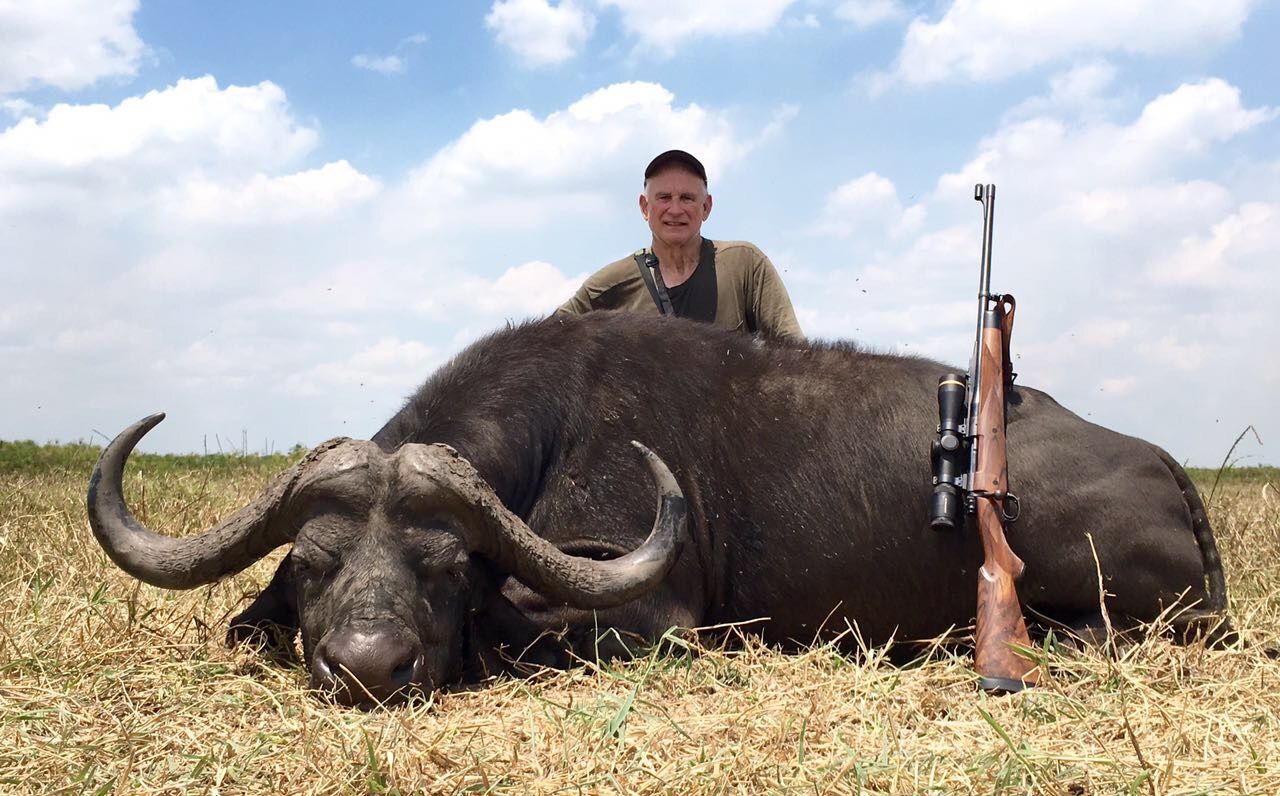
Hunting client with a Cape buffalo bull taken with Nhoro Safaris
Impressed with the diversity and quantity of game in Marromeu!

Scott Perkins & Frank

Safari
Cape buffalo, 2018
Country
Mozambique
Taken
Cape buffalo
Read the full story Show less

Scott and Frank’s Buffalo Hunt

Last month I updated you on Coutada 10 in Mozambique based on a hunt report from Eric Schell, who works with Safari Outfitters and is representing the operator there. Now I have a report from subscriber Scott Perkins who hunted Coutada 10 this past September and confirms much of what Schell told me. Perkins hunted Cape buffalo in the swamp and reports seeing herds of 300 to 600 buffalo daily over the seven days he hunted them. Waterbuck herds numbered in the hundreds. Plus, he reports “quite a few great” eland, plentiful reedbuck, abundant and good nyala and the best sable he has ever seen anywhere in Africa.

Perkins’ safari was organized by Gordon Stark of Nhoro Safaris. Perkins says Stark has an arrangement with concession operator Paul Ferreira of Marromeu Safaris to hunt Coutada 10. Ferreira obtained access to the area in 2012. Perkins’ hunt was in late September when, he says, the waterholes were dry and the buffalo concentrated around the main channel that feeds the delta. Like Schell, Perkins’ hunt employed eight-wheeled ARGOs to travel 10 to 12 miles into the swamp. When they sighted cattle egrets, which follow the buffalo, Perkins says they climbed a palm tree to glass the herd over and proceeded to stalk on foot. He reports finding good to above-average buffalo, including several over 40 inches, but says they were tough to get on for a shot. He ended up taking an askari bull with a broken horn traveling with a very old dagga boy. He says it was the most intense 3½-hour stalk of his life, starting with 35 to 45 minutes on the sticks waiting for a shot. Just as he touched off the shot, the bull moved, and the bullet hit about four inches behind the heart. They tracked the bull through a dense thicket so dark Perkins says he and Stark had to wait for their eyes to adjust. Although the bull did not charge them, Perkins says it absorbed several more shots before finally dropping.

Impressed with the diversity and quantity of game in Marromeu, Perkins also took this excellent Chobe bushbuck early in the hunt.

In addition to the buffalo, Perkins also took what he describes as an “above average” reedbuck and, on the third day of the hunt, an exceptional Chobe bushbuck, completing his spiral horn collection. Perkins was impressed with the area. “You will see a lot of pristine miombo forest, wide open Zambezi Delta swamps, miles of reeds and elephant grass. Basically, an untouched part of Africa,” he says. He gives Marromeu Safaris high marks for the quality of the camp, meals and staff. “You will not want for anything there,” he says. He has already rebooked for next August.

Perkins warns that the heat at this time of year was 114 to 124 degrees. Describing himself as a “mountain boy from Wyoming,” Perkins says, “I damned near passed out from heat stroke.” He also warns of humidity upwards of 80 percent and compares it to steam bath conditions. He advises older hunters and those with heart-related conditions to go earlier in the season (June and July) when the conditions are not as hot or humid. “You can hunt the buffalo in the miombo at that time,” he says. “It is a different hunting experience then and temperatures are cooler.”

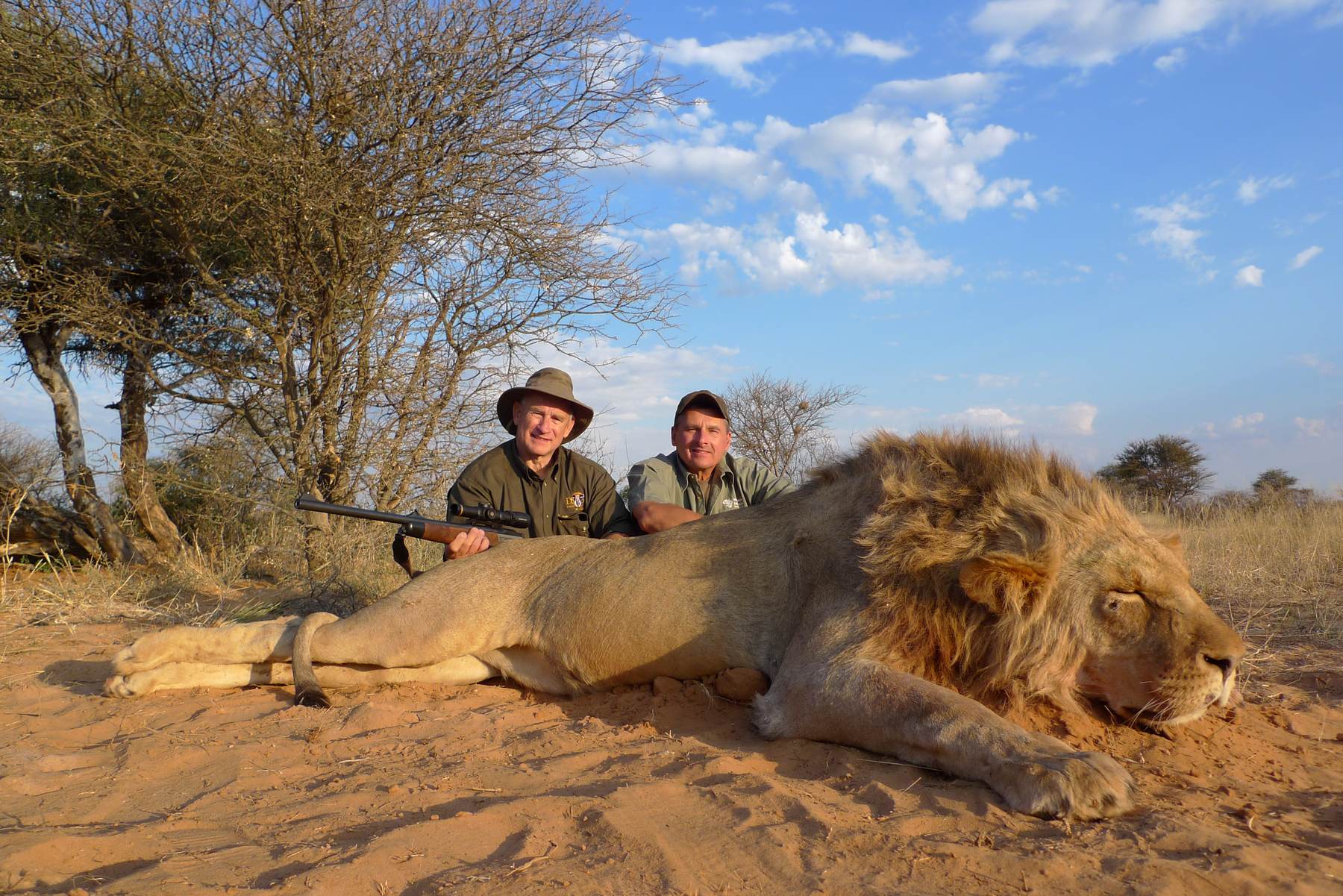
Scott Perkins with his full-maned Kalahari lion, taken with Nhoro Safaris in 2013
The magnificent, fully maned lion, king of the Kalahari made his final death throws and my first game species of the Big Five hunt was over.

Scott Perkins

Safari
Kalahari lion safari, 2013
Country
Kalahari
Taken
Lion
Read the full story Show less

Scott Perkins — Lion Hunt

I just finished my third safari with Gordon Stark of Nhoro Safaris for Cape Buffalo in Mozambique; and every safari keeps getting better and more exciting every trip over to the African continent.

My first hunt with Gordon was May 2012, with my good friend, Frank Fowler, accompanying him on his successful and very exciting stalk and hunt for lioness hunt in the Kalahari. That hunt continued from the Kalahari to the Limpopo district for a plains game hunt.

The concession Gordon operates on in the Limpopo has outstanding hunting opportunities for Kudu, Gemsbok, Eland, Impala, and Waterbuck. The concession was a former black and white rhino breeding ranch and there is a healthy population of both species that was rewarding to see nearly every day in the field. The Limpopo concession offers exceptional, mature bulls of most every plains game species a person has on his bucket list if the hunter is patient and takes the opportunity that the track and animal offers. I harvested a very nice older, dark brown waterbuck bull, a terrific nyala and the Jurassic giraffe bull that the concession managers wanted off the concession as he and another similar aged bull (both long past their breeding age) had killed 6 mature breeding bulls. The waterbuck and nyala are both high Silver SCI ranked. My second hunt was November 2013 back in the Kalahari. My hunting partner, Frank Fowler, and I were after our male lions. This is a stalk and shoot type hunt and not for the faint of heart. Most lion hunting in Africa is done from the safety of a blind over baits.

The Kalahari hunt is spent driving the 3x9 mile blocks with the Land Cruisers looking for cat tracks (spoor) in the ever blowing sand and driving the block to see if the cat has moved through the block or still in the block. If the tracks indicate the cat has not left the block, the hunt is on.

Frank was first up on his lion hunt and barely 20 minutes out of camp the first day we hunted, we cut fresh male lion tracks. Frank and Gordon followed the trackers and 20 minutes into the track spotted a magnificent male watching a small herd of hartebeest from the shade of acacia trees. The stalked to within 22 yds. of the lion who by now fully aware that Frank and Gordon were in his comfort zone. The 416 Rigby barked as Frank cleanly killed his first male lion. The lion was fully mature, not in the pride and has a beautiful Tan and Ginger mane. It scored #37 SCI overall RSA-Namibia.

We spent the next 3 long days searching the vast concession in the heat and dust for fresh cat tracks. We cut a few smaller lioness tracks but no males.

The last morning of the scheduled hunt we pulled out all the stops and had three sets of PH’s and trackers drive the blocks starting at first light. 2-1/2 hours into the tracking that morning, one of the crews cut fresh tracks and followed to freshly killed and consumed young Kudu bull. They drove the block and confirmed that the cat was still in the block. A few minutes later the stalk was on and we followed the fresh tracks through open grass/acacia through very thick sickle bush where we could literally walk up on a bedded lion. All eyes and rifles were on full alert as we pressed on in the pressing heat of the mid- morning.

About 2 hours into the track, we came across a small grove of acacia trees where the lion had scratched up the sand for a cool spot to lay down and digest his Kudu breakfast and continued on another half mile and found where the lion had entered a large warthog hole to get out of the heat and away from his pursuers. We took our first water break of the day and pressed on with the track another few hundred yards. The just-made tracks in the soft Kalahari sand indicated we were bumping the lion not far ahead of us. We decided to take another water break and let the lion find his shade and get settled in before we continued tracking him. With all 5 rifles resting on acacia trees, waters bottles were brought out and one of the PH’s, Dons Els, went behind a sickle bush to relieve himself. Before he unzipped his shorts, he rushed back saying “he’s right therThe next thing I knew someone handed me my rifle and the hunt had jumped in hyper-speed. We spread out in a shooting line rifles at the shoulders, safeties off and fingers resting on the triggers.

Not 20 yards away from the 8 of us were taking our water break, stood the large male lion, tail straight up and watching our every move. I had no idea where anyone was in relation to me other than everyone to my right beyond Juan were a blur in my peripheral vision. The lion was standing in deep shadow and from Where I was standing there was a branch that covered his front chest area. After what seemed an hour, but was only a few seconds, he wheeled to his right hand moved out of the sickle bush without a sound with Juan and I in pursuit.

We followed to him 50 yards to another set of acacia trees where huffed, roared and rattled the 416 Rem shells in pocket and just as he was about to charge the 416 barked in my hands as the 400 grain bullet hit its mark through his left shoulder. He hunched momentarily and took off without a limp to our left another 45 yards to the nearest group of acacia trees where he circled roaring and facing us as if to charge three times. He turned to my right and the 416 barked again as the bullet pierced his right shoulder. He went down on his front knees, whirled and to my utter amazement took off again another 55 yards to the nearest acacia tree he could find and climbed high in the tree until his butt was a full 10 feet off the ground. Juan and I stood there with rifles ready watching him through our scopes. I asked Juan if I should drill him through the shoulder as climbed down, his broken shoulders not able to hold his weight in the tree.

As the lion’s paws raked the barks and slid down the tree trunk his back feet touched the sand and his body was fully extended 10 feet. Juan told me to wait until he stood broadside and then let him have it. As his front feet touched the sand he turned 180 degrees to face to my right and I let go with the third 400 grainer from the 416 and over he went, growling and biting at his fatal wounds. I don’t remember filling the magazine as we ran and followed the lion in between shots; but as I opened the bolt to check the magazine, there were three rounds ready to go. I jacked the fourth round into the chamber and administered the coup de gras.

The magnificent, fully maned lion, king of the Kalahari made his final death throws and my first game species of the Big Five hunt was over. Hands reached out to shake mine, pats on the back and bottles of water were put in my hand. It was a boyhood dream that I never thought possible that had just been fulfilled. All those stories from Bell, Rouark, Capstick had a new chapter with a thrilling and safe conclusion - no scratches, and plenty of high drama. After the requisite pictures were taken and with much effort, six of us loading him into the Land cruiser; the adrenaline hit every muscle fibre in my body and I couldn’t stop shaking until I had 3 stiff scotches and 2 hours of recanting every step, every time the lion and I made eye contact and me recalling every roar that literally rattled the 416 rounds in my left pocket. It’s been two years now since that hot dusty morning in the Kalahari sand I still get a racing earth and pulse writing these words. I hope I never lose that type of palm sweating memory until my final moments on this Earth.

Nhoro Safaris clients in the back of the hunting vehicle in the Zimbabwe bush
Tomorrow we must leave for home.

Paula Haydon

Safari
Elephant safari, 2018
Country
Zimbabwe
Taken
Elephant
Read the full story Show less

The Last Chance Elephant

As we climbed down from the truck, the moon was in the shape of an elephant tusk, and Orion, the constellation of the hunter, was bright in the sky.  Dave Haydon took that to be an auspicious sign and the excitement continued to build. My husband and I had decided to go to Zimbabwe just 3 weeks earlier, after hearing that Gordon Stark, our outfitter and PH, had a cancellation.  Because Dave had a very successful buffalo hunt with Gordon in 2005 it was impossible to pass up this trip. Gordon works very hard to make every trip interesting and fun as well as successful.  I was along as photographer because Dave couldn’t get a hunting buddy on such short notice.  It was only my 3rd African trip with Dave and turned out to be a physically demanding, yet wonderful adventure. I was very glad I was there.

During the previous 5 days we spent time interviewing villagers, studying elephant tracks, roaming dirt roads and fields looking for sign, and waiting in ambush while the elephants went in another direction.  On a lonely dirt track, Dave had missed a chance at a big one by seconds and passed on a shot at a small one.  One day was spent hiking quickly across veldt, up and down steep, rocky terrain, and crossing streams while hot on the trail of a big bull.  We pulled closer and closer and the sign got fresher and fresher.  At last we arrived at a stream that bordered a preserve, where we’re not permitted to hunt.  That old bull had out-raced and out-smarted us!  And now we would have to start over.

Tomorrow we must leave for home.  We spent the morning in the villages and scouting the back ways for a hint of tracks.  Elephants had killed 6 people in the last 4 months – we knew they were in the area.  But where?  Gordon sent people out in all directions in hopes of finding fresh signs and news.  From all the information gathered, it sounded like there were two likely locations and it was decided we would set up in a cornfield that afternoon.  The trackers spread out and we waited and waited.  In the early evening we were told that two elephants tried to cross a road and head our way but were frightened off by a car.  So, we waited again while watching the sun set and the moon rise.

Suddenly, we received word that a large bull had been spotted in a cornfield about two miles away.  We rushed to the trucks and were off on a fast and bumpy ride.  When we arrived, there were a dozen villagers waiting to show us the general area.  However, we wondered if we could find anything, even something as big as an elephant, in the dark. We walked down a little dirt road and then left the villagers in a safe spot while we forged on.  Dave and I were counting on the great experience that Gordon and his team brought to the hunt.  We also appreciated their hearing and sight, both excellent compared to ours.  As we walked through the fields, we seemed as noisy as a whole army because we were stepping on dried corn stalks.  With its big ears the bull surely knew we were headed its way.

At last a large light shadow showed in the dark and was stationary as we approached.  In the dark it was hard to tell how far away we were, but Gordon and Jeb thought we were pretty close.  Dave stepped to the front and prepared to shoot his 375 H & H.   Gordon told him that Jed was going to shine a light on the elephant and Dave should shoot immediately.  He needed to hit him just behind the shoulder, into the lung and heart.  Jed turned the light on and there he was, a big bull about fifty-five yards away and facing us.  As soon as the light went on, he started turning to our left and Dave shot.  Was it a good hit?  It was too dark to be sure.  Gordon took a backup shot but the elephant was spinning away and then Dave took another shot for the spine.  He must have missed the spine because the animal kept going.  The elephant ran and disappeared in the dark.  Even with a perfect shot, many animals will run for long distances before dying.  Was this one fatally wounded?

His trail was found and carefully followed.  No blood.  Wait!  There are some red spots on those leaves!  And so we followed.  After a few minutes it was realized that some of the leaves had a red pigment that naturally showed up at night.  We backtracked to where we had turned off and found the true trail again.

Hiking through 250 yards of downed corn stalks, crossing trampled barbwire fencing, and tracking across a field, we occasionally spotted a bit of blood.  Shouldn’t there be more?  We finally arrived at a thick wall of heavy shrubbery and trees.  There was blood on the ground and a bit on the branches.  Dave, Jed, and Gordon all had their guns ready.

Gordon and Dave slowly stepped forward.  Gordon used the barrel of his gun to move a few branches away and see what was beyond.  There was the elephant, facing us from just feet away on the other side of the leaves and branches, lying on the ground and exhaling his last breath.  He had gone into the brush and turned so that he could charge us when we arrived.  Thank heaven we’d lost the trail for a few minutes!  The great bull died quickly because Dave had made a perfect shot to the lungs and heart area.

  The blood bubbled out of his nose and mouth as he exhaled, and we couldn’t help but feel sorrow at the loss of such a magnificent animal.  As a sign of respect, Dave performed the tradition of Letzter Bissen and placed some greenery in his mouth, representing his last meal.

We send a sincere Thank You to Gordon Stark of Nhoro Safaris, Jed, Pierson, and all the team for an exciting adventure.

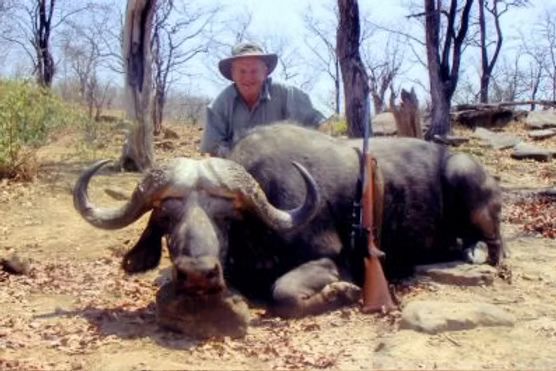
Tony Denison with his Cape buffalo bull taken with Nhoro Safaris
Although it exceeded 44” it was soft on top, so it was decided to let it go.

Tony Denison

Safari
Cape buffalo, 2018
Country
Mozambique
Taken
Cape buffalo
Read the full story Show less

Tony Denison’s Cape Buffalo Hunt

This hunt took place at the end of September and into the first part of October 2007. Tony Denison from Cazenovia, NY hunted for Cape buffalo in Zimbabwe. Tony flew into Harare, the capital, and was met at the airport by his two PH’s, Gordon Stark and Philip Reed, owners of Nhoro Safaris.

Then they all drove for approximately seven hours to the Zambezi Valley where they camped. Tony was using a 458 Ruger Magnum with a 450gr. Barns XXX bullet. Although they heard of all the troubles that were occurring in Zimbabwe, they found the people very friendly and passed through the check points without any problems. The food is very scarce for the natives, but they all seem healthy and accommodating. The first three days were spent looking for a good size cape buffalo. They spotted a huge bull in a large herd and spent two days trying to get a good look at that bull. What Tony was looking for was a deep curl with a heavy boss. During the second day, they maneuvered  in front of the herd and got a good look at the bull.

Although it exceeded 44” it was soft on top, so it was decided to let it go. The next day five dugaboys were spotted, including one old bull with a very deep curl and heavy boss. It was decided to take that animal. It took a couple more hours to get in front of him and to get into a good shooting position. As night was coming on, they had to hurry. They crossed a dry riverbed and climbed a mountain, which had the animals coming right at them. They were running out of daylight when Tony finally got his shot. The bull bolted down the mountain and across the dry riverbed into the heavy jess. Because it was getting dark, they decided to go after the bull the next morning. They then recovered the animal and transported it back to camp. The bulls’ horns measured 38 ½” wide with a 13 ½: boss, which was everything Tony wanted.

Now after the successful hunt, the PH’s asked Tony if he would like to fish. Since there were 2 ½ days left, Tony said yes. So the next morning they drove about three hours to fishing camp on the Zambezi River. What a fantastic way to finish a safari! They fished for tiger fish, which put up a heck of a fight! While floating down the river, they went by many pods of hippos and many crocodiles. On shore they passed a large number of elephants and many species of antelope.

Tony’s safari was the best anyone could ask for. As a result, he has made arrangements to return this fall, with the same PH’s, to hunt for elephant

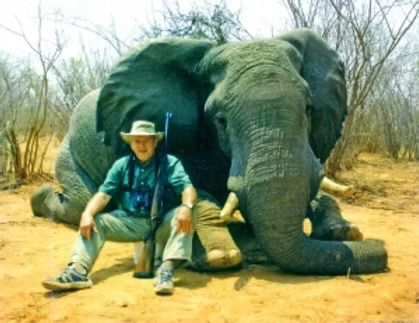
Tony Denison with his trophy bull elephant taken with Nhoro Safaris
The animal dropped immediately into a sitting position.

Tony Denison

Safari
Elephant safari, 2018
Country
Zimbabwe
Taken
Elephant
Read the full story Show less

Tony Denison’s Elephant Hunt

Early in October Tony Denison returned to Africa for an elephant hunt, again with Nhoro Safaris.  He hunted with his PH’s Gordon Stark and Phillip Reed.  Tony hunted with his Ruger 77 in 458.  The load he used was 75 grains of accurate 2230 and a Barnes solid 450 grain with a speed of 2263 fps.  The hunt was made in the Chirisa Safari area in Zimbabwe.  Three or four days into the hunt the trackers found three nice bull tracks.  They picked them up early, at daylight, and jumped them around 8 o’clock.  We then returned to the truck, to give the elephants a chance to calm down.  At about 10:30 AM they all went back, to where they had left the elephants and the trackers went to work again.  After walking all afternoon, in 100 degree weather, the trackers finally heard the elephants around 4:30 PM.  Their entire group had to circle around the animals to keep the wind in their favor and finally saw them just before 5 o’clock. 

They were hunting in very heavy Mopani bush, so to get a clear shot they had to get very, very close.  They had gone about 10 yards, trying to get a clear brain shot, when one of the elephants lifted his trunk and was aware that something was not quite right.  The group had discussed what they would do in case of different scenarios, but they were sure, due to the density of the bush, that they would only get one shot.  So if they could not get a shot in the brain, or heart and lung, or a spine shot, they would have to let the animals go.  The elephant wheeled so the only shot Tony had was to the spine.  The animal dropped immediately into a sitting position.  He then walked around the elephant and put two rounds into the brain.

Looking at his watch, it was just 5 o’clock.  They checked their GPS and saw they were about 5 miles from the truck, so they decided not to try to get any photos that day because it was already getting dark.  They got out to the truck when it was pitch black and drove back to camp.

  They were up at 4:30 AM the next morning, had breakfast and started back to where the truck was parked the night before.  They brought with them seven additional skinners, because they had to cut a road into the elephant five miles.  They got to the elephant at about 3:30 in the afternoon.  They cleared the area in order to take photos and then the skinners started their long task.  The group got back to camp at 9:30 that night.  That ended a fantastic and successful elephant hunt.

The next day Tony decided to shoot a big Kudu, if they could find one.  Although they saw plenty, they did not find one in the 55+ inch range.  So they passed those up.Tony had planned after the hunt to visit Victoria Falls.  So the next day Tony and Gordon left camp and drove six hours to the falls.  They had a very nice lunch at the Victoria Falls Inn and then called it a day.  The following day they walked up to the head of the falls where there is a large bronze statue of Dr Stanley Livingston.  They proceeded on, taking photos along the way, for approximately a mile.  They spent the rest of the day touring the Victoria Falls area.

The next day Gordon Stark introduced Toney to a friend of his in Botswana.  He gave them a personal tour through Chobi National Park by car and boat.  The following day Tony had to get back to Bulawayo for his flight home.  What a fantastic way to finish a safari!  He is looking forward to the next one.

Hunted with us before?

If you would be willing to have your hunt written up here, we would be glad to have it. Send us a few lines about the trip and a photograph, and we will never publish your name without asking first.

Send us your story

Write the next one

Tell us what you want to hunt and roughly when you can travel. We will come back with honest options.

Start an enquiry
WhatsApp