Elephant is the hunt people spend twenty years thinking about before they book it. It is also the one where the gap between what people imagine and what actually happens is widest. Here is what we tell every client before they commit.
It is a walking hunt, and that is not a figure of speech
Fourteen days. Fifteen to twenty kilometres a day, in heat that regularly passes thirty-eight degrees, over ground that is sand, rock, and thorn in roughly equal measure. Some days you will follow one set of tracks for eight hours and end the day further from camp than you have ever walked in your life, with nothing to show for it.
This is the single most common reason an elephant hunt disappoints. Not the quota, not the ivory — fitness. But it is not a wall, it is a conversation. We hunt elephant in more than one kind of country, and if twenty kilometres a day is not realistic we put you on ground where it does not have to be. What we cannot do is guess. Tell us honestly what you can walk at the enquiry stage and we will build the hunt to suit it.
If you want to prepare, walk. Not the gym, not running — walking, with a daypack, in the boots you will hunt in, on uneven ground, building to four or five hours at a stretch. Start six months out.
Why Zimbabwe
Zimbabwe has the elephant population, the wild ground, and a licensing structure that supports genuine free-range bull hunting. Our concessions sit in the Zambezi Valley and in areas bordering Hwange, both unfenced, both large enough that elephant move across them following water and browse without regard for where you happen to be standing.
There is no supplementary feeding and no guarantee. The bull you find on day eleven may be forty kilometres from where you started on day one.
Quota is small and dates go early
Zimbabwe allocates elephant on a strict annual quota set by the wildlife authority. The number of bulls available across our concessions in any given year is measured in single figures. Dates typically book twelve to eighteen months ahead, though six months can sometimes be done if quota is still open.
If you are reading this in the hope of hunting next season, the honest answer is probably not. Start the conversation now for the season after.
How a bull is judged
Everyone asks about ivory weight and it is the wrong first question.
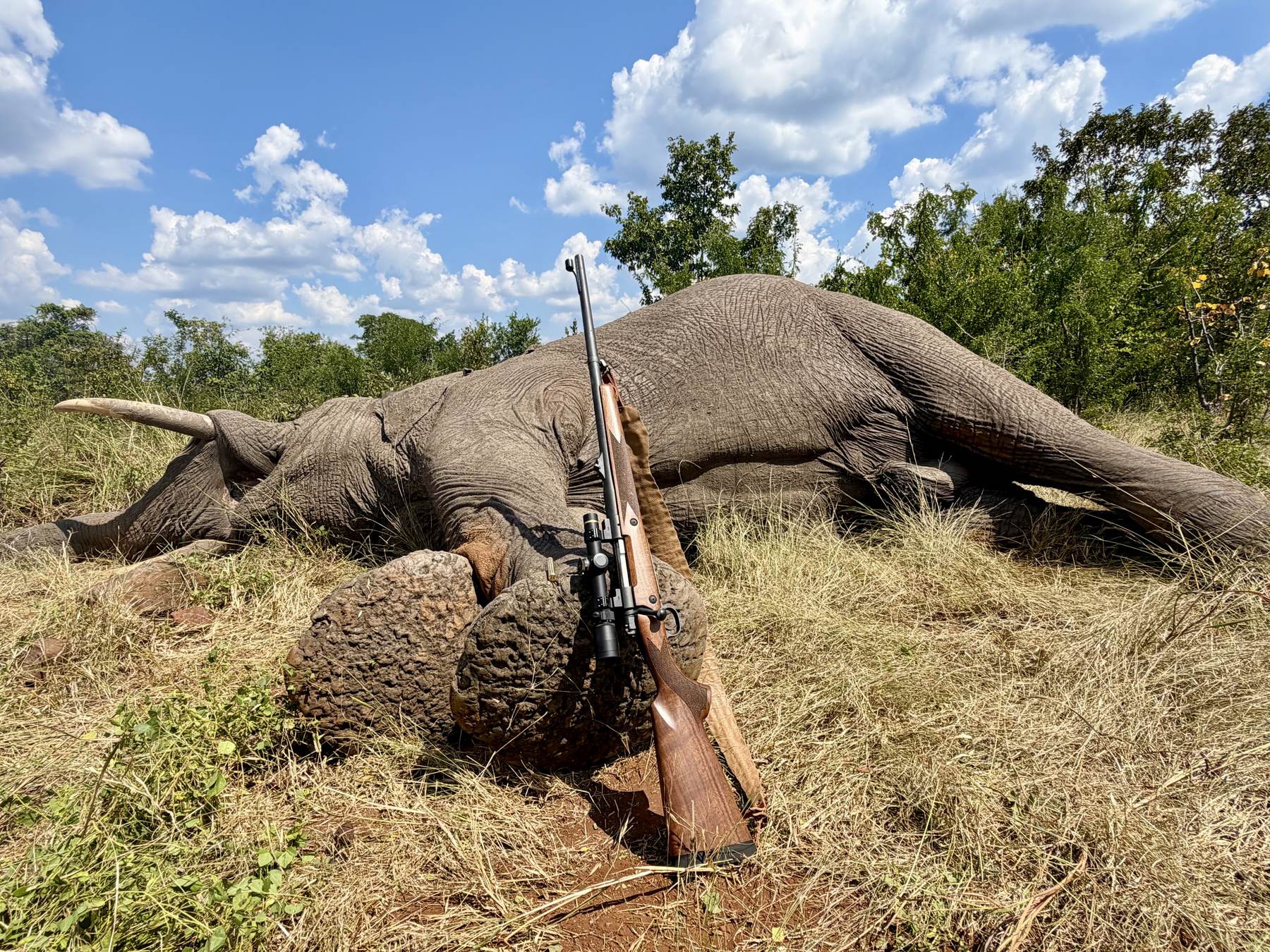
What we look for is age. An old bull past breeding age — thin over the shoulders and hips, hollow above the eyes, with worn and often broken ivory — is the right animal both ethically and legally. He has bred. Taking him has no meaningful impact on the population, and he is likely in his last years regardless.
Weight follows age imperfectly. A genuinely old bull might carry forty pounds a side because he snapped a tusk twenty years ago pushing over a tree. He is still the right animal. A representative bull from our areas runs forty-five to fifty-five pounds a side, and bulls above seventy do come out, but they are rare and they are getting rarer everywhere in Africa.
Most of our clients pass on at least one bull. That is a good sign.
Rifles
Zimbabwe sets .375 H&H as the legal minimum. It works, and it has worked for a century. Most experienced clients bring more — the .416 Rigby and .458 Lott are the two most common heavy rifles in our camps.
Bring solids. Monolithic or steel-jacketed solids that drive through bone in a straight line without deforming. Softs have no business in elephant hunting.
Practise offhand at fifteen to thirty metres, because that is where you will shoot. We will spend time before the hunt on the sticks and on an elephant skull diagram, working through brain and heart-lung shots and the angles that make each one available. The decision itself gets made in about four seconds, in thick cover, with your professional hunter beside you.
The last thirty metres
The final approach is almost always inside thirty metres and frequently much closer, in jesse bush thick enough that you see the bull in pieces rather than all at once — a patch of grey, the shape of a tusk, an ear moving.
Everything up to this point depends on wind. Elephant have extraordinary hearing and an even better nose, and poor eyesight. When the wind swirls, and in the valley it swirls constantly, you back out and circle. Sometimes you do that four times on the same bull.
CITES and getting the trophy home
Elephant is CITES-listed. We arrange the export permit and veterinary documentation as part of your trophy shipping. The import side is yours, and this is important: rules on elephant trophy import have changed repeatedly over the last decade and differ substantially between countries.
Check where your own country stands before you book, not after you have taken a bull. We will tell you what we understand the position to be, but verify it independently. See our firearms and CITES notice for more on where responsibility sits.
What it is actually like
Long days, a great deal of silence, and a lot of walking that goes nowhere. Then twenty minutes that you will remember with complete clarity for the rest of your life.
Read the elephant species page for seasons and trophy detail, or talk to us about which season suits you.