The animal
The largest living bird, and one that gave up flight to become something closer to an antelope.
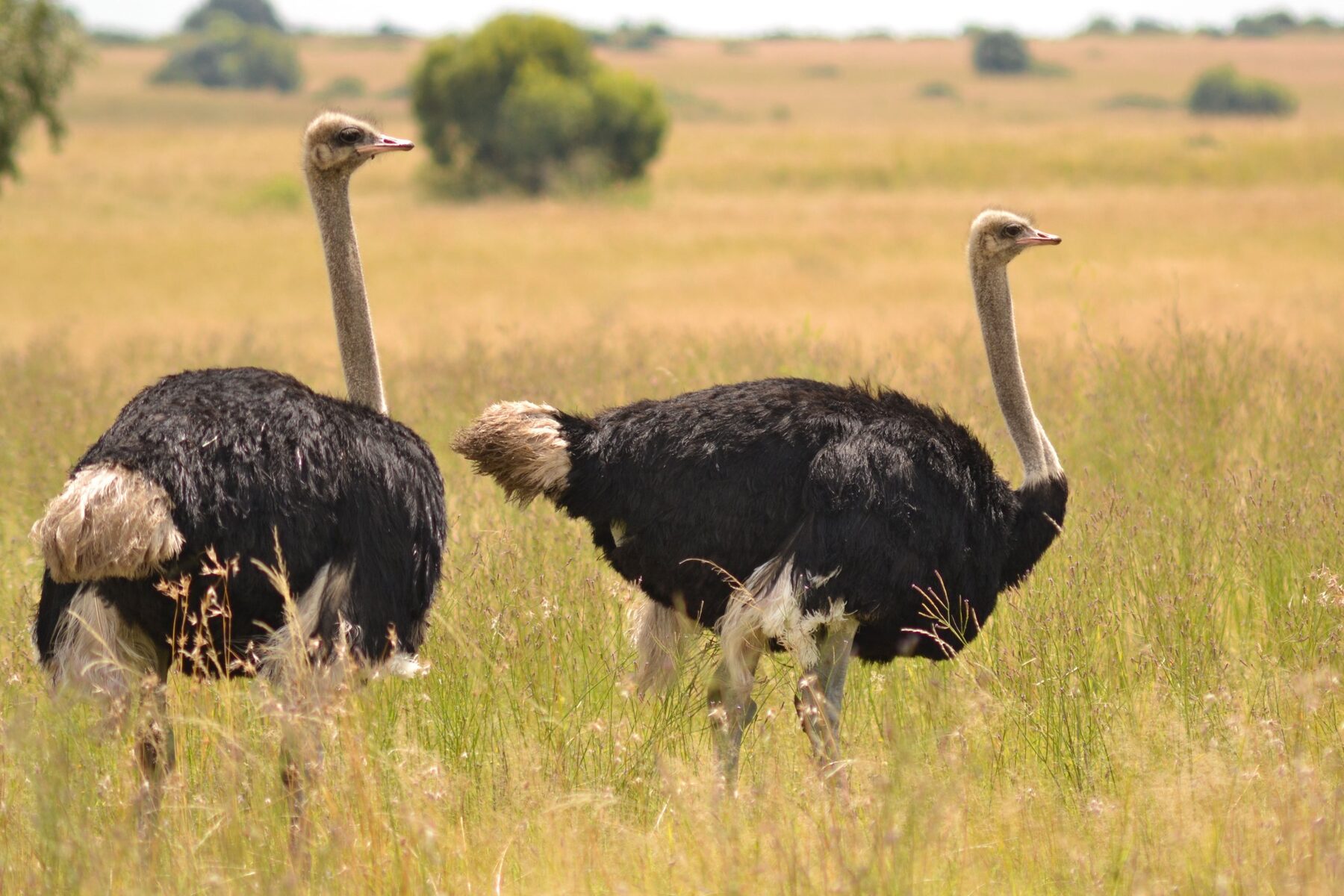
A mature cock stands well over two metres and weighs a hundred and twenty kilograms or more. He is black with white wing and tail plumes; the hen is a uniform grey-brown, and the difference is obvious at any distance. The eye is the largest of any land vertebrate — bigger than the brain — and they see a very long way across open ground.
They run at seventy kilometres an hour and sustain fifty for a long way. Each foot carries two toes, and the inner one has a claw that an ostrich kicks forward with, with enough force to be genuinely dangerous. People have been killed by cornered ostrich. Do not approach a wounded one.
The old story about burying their heads in sand comes from the nesting bird lowering its neck flat to the ground to be less visible. It works rather well, which is why you will walk past them.
How the hunt runs
On foot, in the open, and the open ground is the whole problem.
Ostrich live where they can see, and they can see better than you. There is rarely cover to work with, there is almost never a quiet approach, and a bird that decides to leave is gone over the horizon at a pace nothing follows.
The hunt is a long spot-and-stalk using whatever ground there is — a fold, a line of scrub, a drainage. Shots tend to be longer than you would like. Expect to spend a morning on it and expect to be seen at least once.
Bow hunting them is possible and considerably harder.
Rifle and shot placement
Your plains game rifle, .243 through .30-06, with a standard expanding bullet.
Placement is the whole thing. An ostrich is mostly feathers and legs, and the body is much smaller than the outline suggests — the vital area sits low and well forward, roughly where the base of the neck meets the body. Hunters who aim at the middle of the visible bird shoot through plumage and nothing else.
Ask your professional hunter to show you the point of aim before the stalk. It is not intuitive.
A wounded ostrich is dangerous at close quarters in a way most hunters do not anticipate. Let the PH handle the follow-up.
Practicalities
Hunted on our South African ground as part of a plains game safari.
The feathers, the skin and the eggshell all travel well and most clients take something home even if they do not want the full bird. Ostrich leather is distinctive and genuinely valuable, so tell the skinners before the shot if you want the hide prepared for tanning rather than a mount.
Full mounts are large, striking, and expensive to ship. Think about the shipping before you commit to one.
Import rules differ by country. Check your own position before booking. See our firearms and CITES notice.